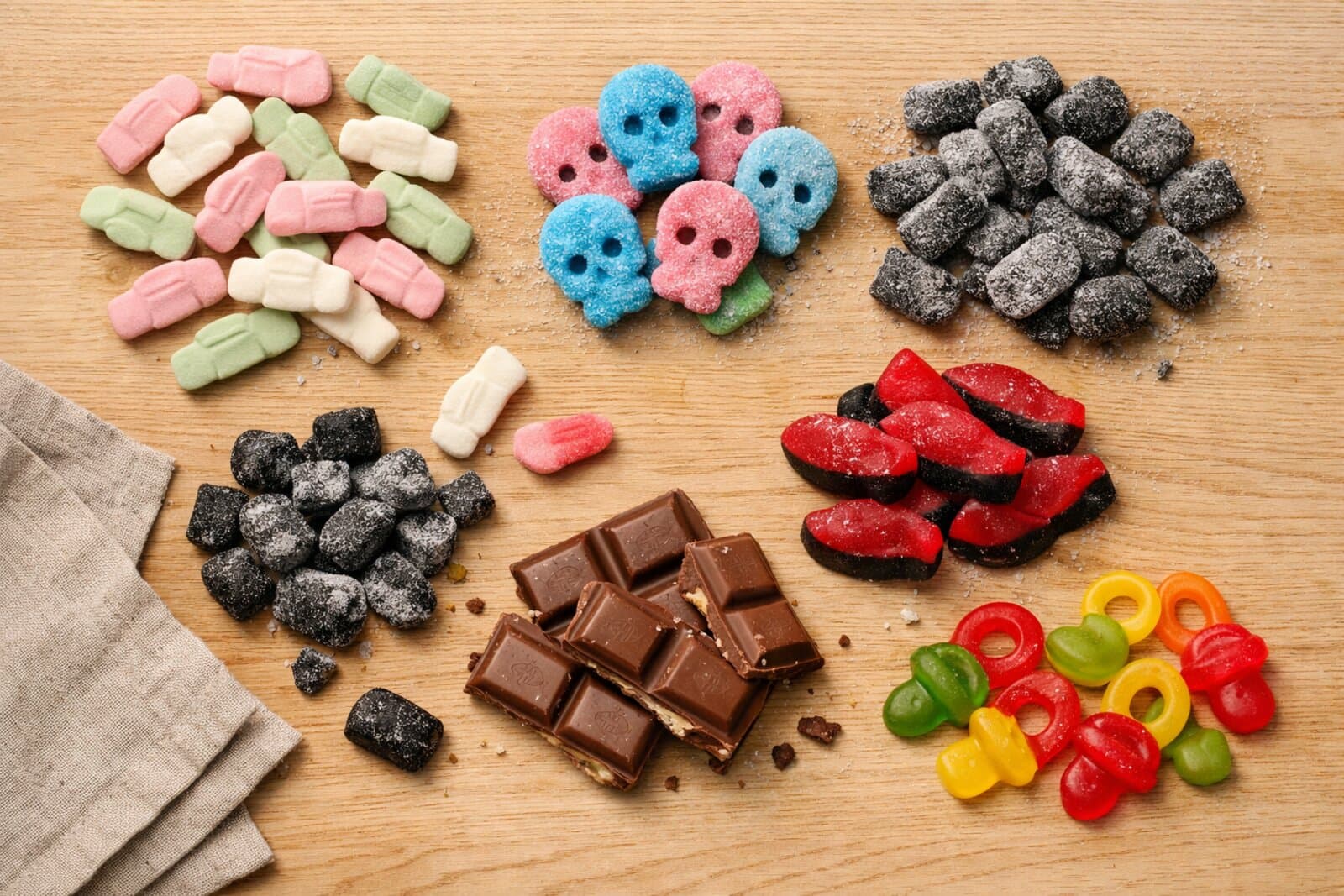
Fazer isn't technically Swedish — it's Finnish. But in Scandinavia, borders blur when it comes to candy. Fazer's blue chocolate bar is as iconic in Sweden as it is in Helsinki, and their Tyrkisk Peber is one of the wildest licorice experiences you can have.
Quick Fazer Facts
- Founded: 1891 by Karl Fazer in Helsinki, Finland — as a "French-Russian cafe"
- Fazer Blue launched: 1922 — the blue wrapper symbolized Finnish patriotism after independence (1917)
- Tyrkisk Peber: Created in 1977 — one of the most intense salmiak candies ever made
- Employees: 6,000+ across 8 countries
- Status in Sweden: Sold everywhere, loved by everyone — Swedes often assume it's Swedish
A Swiss-Finnish Confectioner Who Defied His Father
Karl Fazer was born in Helsinki in 1866 to a Swiss family that ran a fur business. His father wanted him in the family trade. Karl wanted to make candy. He won.
After studying baking and confectionery in Berlin, Paris, and Saint Petersburg, Karl opened a "French-Russian cafe" at Kluuvikatu 3 in central Helsinki on September 17, 1891. The cafe served pastries, chocolates, and confections made with techniques Karl had learned across Europe. It was an immediate success.
What Karl understood — and what would define Fazer for the next 130 years — was that quality ingredients and careful craftsmanship mattered more than volume. He sourced the best cocoa he could find, used fresh cream and butter from Finnish dairy farms, and refused to cut corners even when scaling up production.
This philosophy was radical for the 1890s, when most confectioners prioritized shelf-stable products over flavor. Karl Fazer bet that Finnish consumers would pay a premium for genuinely good chocolate. He was right.
Fazer Blue: The Bar That Became a National Symbol
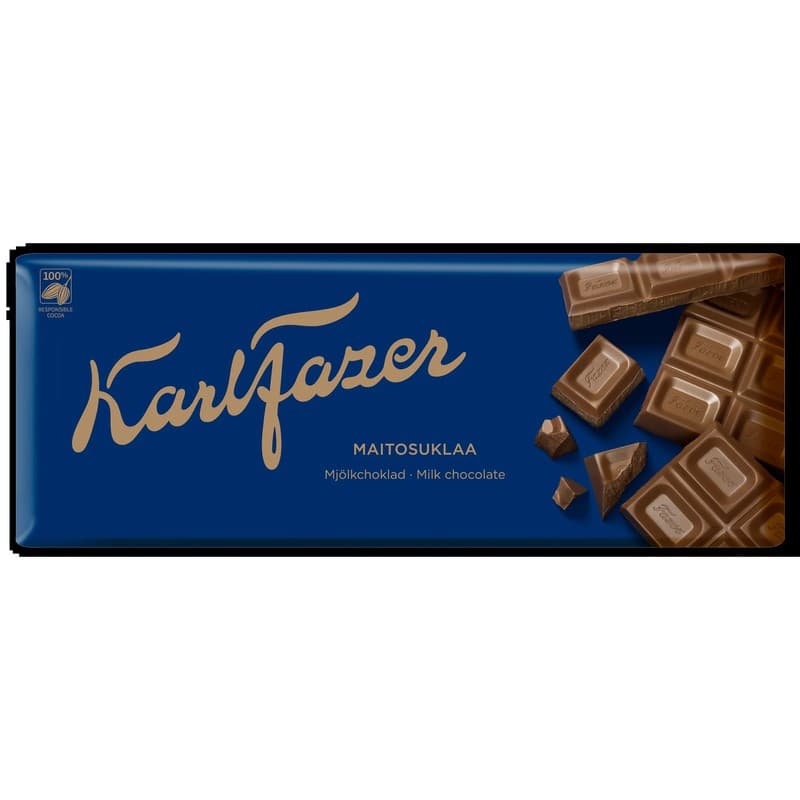
Fazer Blue (Karl Fazer Milk Chocolate) launched in 1922. The timing was deeply significant: Finland had declared independence from Russia just five years earlier, in 1917. Karl Fazer chose the iconic blue wrapper as an act of patriotism — blue being one of the colors of the Finnish flag.
This wasn't just marketing. It was identity-building. In a young nation still establishing itself, Fazer Blue became associated with Finnish independence, Finnish quality, and Finnish pride. Every time someone unwrapped a Fazer Blue bar, they were making a small statement about Finnish values: craftsmanship, quality, and self-determination.
The chocolate itself justified the symbolism. Fazer Blue uses a specific recipe that calls for a higher proportion of fresh milk than most European milk chocolates. The result is a distinctly creamy, smooth bar with a flavor profile that's different from both Marabou and Cadbury. Where Marabou has caramel undertones from its processing, Fazer Blue is cleaner and more dairy-forward. It tastes like what you imagine "pure milk chocolate" should taste like.
In 2022, Fazer Blue celebrated its 100th anniversary — a century of continuous production with essentially the same recipe. That's remarkable in an industry where reformulation is constant. Fazer has resisted the temptation to modernize, reduce costs, or "innovate" their flagship product into something different. The recipe that worked in 1922 still works today.
Why Fazer Blue Works in Sweden
Here's the interesting thing about Fazer Blue's dominance in Sweden: it's a Finnish product competing on Marabou's home turf, and it does extremely well. Many Swedes keep both brands in their regular rotation — Marabou for its caramelized depth, Fazer Blue for its clean creaminess.
Swedish candy shops stock Fazer Blue alongside Marabou without any sense that one is "foreign." In practice, Fazer functions as a Scandinavian brand rather than a strictly Finnish one. The Nordic candy market doesn't respect national borders the way other industries might.
Tyrkisk Peber: The Salmiak That Changed Everything
If Fazer Blue is Finland's polite, universally-loved export, Tyrkisk Peber is its unhinged cousin. Created in 1977, Tyrkisk Peber (Turkish Pepper) is one of the most intense salmiak candies ever produced.
The concept: hard candy shells filled with salmiak powder. When you suck on the candy, you get a conventional hard candy experience — sweet, slightly peppery. Then you hit the center. The salmiak powder explodes across your tongue with a sharp, salty, almost burning intensity that makes most Americans physically recoil.
Tyrkisk Peber is not a beginner candy. It's not even an intermediate candy. It's the candy that salmiak enthusiasts use to test whether someone is truly committed to the Nordic salty licorice experience. The ammonium chloride content is significantly higher than typical salmiak products, and the powder format means the full dose hits your taste buds all at once rather than gradually.
Despite — or perhaps because of — its intensity, Tyrkisk Peber has a devoted cult following across Scandinavia and among international candy collectors. It's the product that appears in every "trying Swedish/Finnish candy" YouTube video, usually accompanied by dramatic facial expressions and genuine confusion from the taster.
Beyond Blue and Peber: Fazer's Full Range
Karl Fazer Dark Chocolate
Fazer produces several dark chocolate variants at different cocoa percentages (47%, 70%, 80%). These are excellent examples of Nordic dark chocolate — less bitter than Belgian dark chocolate, with a subtle creaminess that reflects Fazer's dairy expertise. The 70% is the sweet spot for most people.
Fazer Salmiakki
A softer entry into the salmiak world than Tyrkisk Peber. These are chewy salmiak candies with a more measured ammonium chloride content. If you're curious about Nordic salmiak but scared of Tyrkisk Peber, Fazer Salmiakki is the training ground.
Fazer Liqueur Fills
Chocolate pralines filled with various flavored liqueur creams. These are the Fazer products that appear during Finnish and Swedish holidays — Christmas and Easter especially — in elegant boxes designed for gifting. The quality is genuinely impressive for mass-market pralines.
Fazer Dumle
Soft toffee pieces covered in milk chocolate. Dumle competes with Daim in the chocolate-toffee category, but with a completely different approach: where Daim's toffee shatters, Dumle's toffee stretches and chews. It's a softer, more forgiving candy that appeals to people who find Daim's hardness too aggressive.
Fazer Geisha
Milk chocolate bars filled with hazelnut nougat. Geisha has been a staple since the 1960s and remains one of Fazer's strongest sellers after Fazer Blue. The nougat is smoother and less sweet than Nutella, with a refined hazelnut flavor.
Fazer's Manufacturing Philosophy
What separates Fazer from many global confectionery companies is that it remains family-owned. Unlike Marabou (owned by Mondelez), Fazer is still controlled by the Fazer family through a family holding company. This independence means Fazer can make long-term quality decisions without pressure from public shareholders to cut costs every quarter.
The company's main factory in Vantaa, Finland (built in 1963 in a forested area chosen for its natural water resources) produces the majority of Fazer products. The factory has been continuously expanded and modernized, but the core production philosophy remains Karl Fazer's original vision: best ingredients, careful processing, no shortcuts.
Fazer employs over 6,000 people across Finland, Sweden, Latvia, Lithuania, Estonia, Denmark, Norway, and Poland. The company has been expanding its presence across the Nordics and Baltics, but growth has been deliberate rather than aggressive — another advantage of family ownership.
Fazer vs. Marabou: The Nordic Chocolate Debate
Ask any Scandinavian which is better — Marabou or Fazer — and you'll start a debate that never ends. Both brands represent the pinnacle of Nordic chocolate, but they're genuinely different products.
Marabou has caramelized depth from its 1950s processing innovation. It's slightly warmer, with toffee-like undertones. The texture is smooth but structured.
Fazer Blue is cleaner and more dairy-forward. The creaminess is more pronounced, and the cocoa flavor is less processed. The texture is silkier.
Neither is objectively better. They represent two different approaches to Nordic milk chocolate, and which you prefer depends entirely on what you value in chocolate. Many Scandinavians don't choose — they keep both in rotation.
For a broader comparison, see our complete guide to Swedish chocolate and best Swedish chocolate brands.
Where to Buy Fazer in the US
Fazer products are widely available through online Nordic candy retailers. Fazer Blue is the easiest product to find, followed by Tyrkisk Peber and the salmiakki range. Physical Scandinavian shops in major US cities (like Sockerbit in NYC) typically stock a selection of Fazer products.
For the freshest selection and best prices, check our where-to-buy guide.
Shop authentic Swedish candy from trusted retailers with fast US shipping.
Frequently Asked Questions
Is Fazer Swedish or Finnish?
Finnish. Founded in Helsinki in 1891 by Karl Fazer. However, Fazer products are sold extensively throughout Scandinavia and are as common in Swedish stores as domestic brands. Many Swedes don't think of Fazer as foreign.
What does Tyrkisk Peber taste like?
Intense. The outer shell is a hard candy with peppery notes. The center is pure salmiak powder — aggressively salty, slightly metallic, with an ammonium chloride burn that lingers. It's not for beginners. If you want to understand salmiak culture, try milder options first.
Is Fazer still family-owned?
Yes. Unlike most major confectionery brands, Fazer remains controlled by the Fazer family through a holding company. This independence is a point of pride and allows long-term quality decisions without shareholder pressure.
Is Fazer Blue better than Cadbury Dairy Milk?
Different products with different philosophies. Fazer Blue uses more fresh milk and has a cleaner flavor. Cadbury Dairy Milk has higher milk powder content and more pronounced vanilla notes. Most taste tests favor Fazer Blue, but preferences are subjective.
Does Fazer use palm oil?
Fazer has committed to responsible sourcing and has been working to minimize or replace palm oil in their products. Check specific product labels for current formulations.
The Fazer Legacy
Karl Fazer opened a cafe in 1891 because he believed Finnish people deserved world-class confections. Over 130 years later, his company still operates on that principle — family-owned, quality-focused, and deeply embedded in Scandinavian culture.
Fazer Blue remains the gold standard for Nordic milk chocolate. Tyrkisk Peber remains the ultimate salmiak challenge. And the company itself remains proof that you don't need to be acquired by a global conglomerate to compete globally.
Start with Fazer Blue to understand the baseline. Then decide how brave you're feeling about salmiak.
Founder & Editor
Former Swedish candy & FMCG professional turned US-based founder of SwedishCrave. Built the site to fill the gap he saw when he moved stateside.