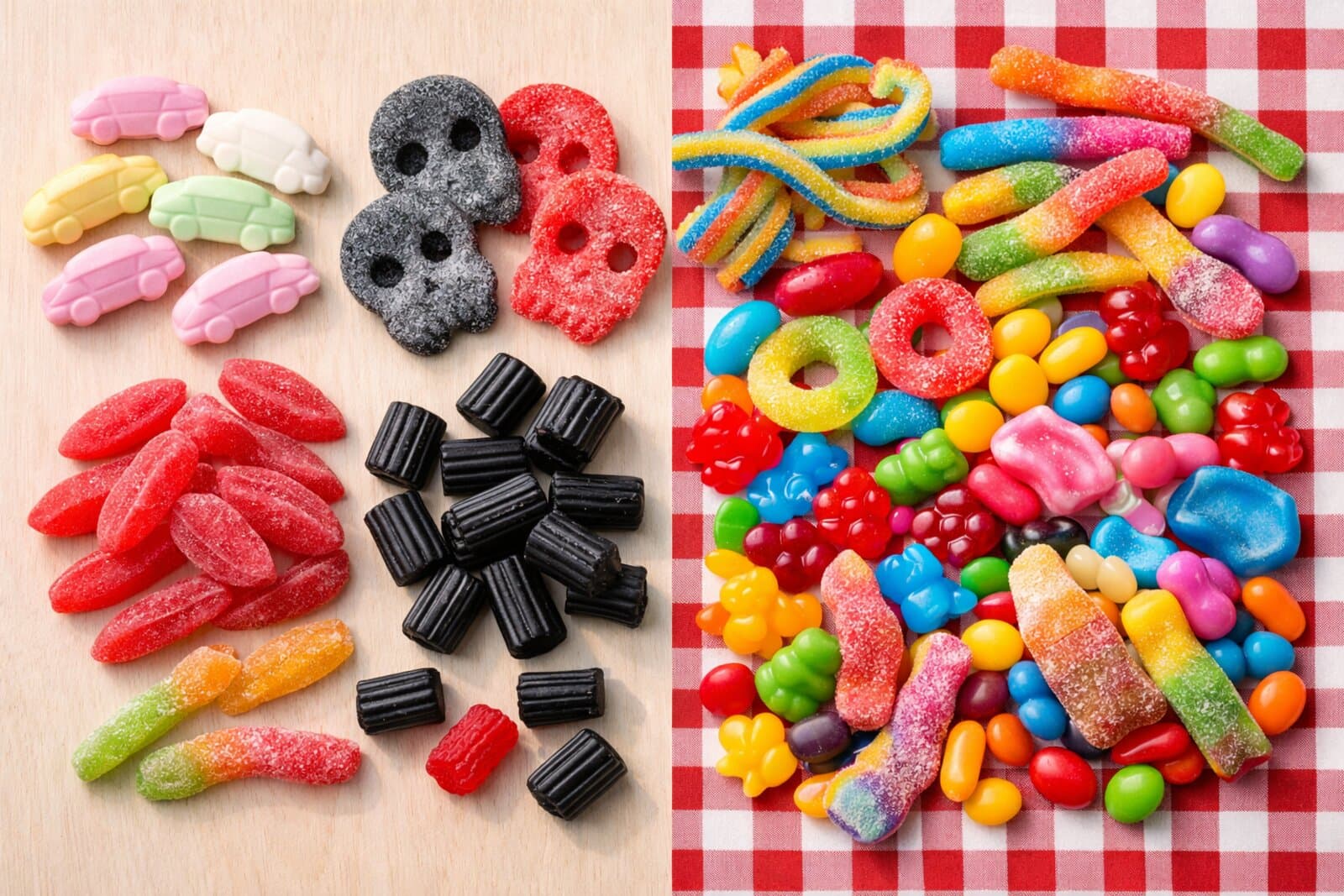
The colorful difference between Swedish and American candy isn't just aesthetic — it's chemical. EU regulations push Swedish candy makers toward plant-derived colorings, while the US still allows artificial dyes that are restricted or banned elsewhere. Here's exactly what's different and why it matters.
The Dye Divide: American Artificial vs Swedish Natural
Pick up a bag of Haribo gummies in the United States and scan the ingredient list. You'll likely see Red 40 (Allura Red), Yellow 5 (Tartrazine), Yellow 6 (Sunset Yellow), and Blue 1 (Brilliant Blue). Now grab the same Haribo from a Swedish store. The ingredient list is different. These synthetic dyes are either absent or replaced with plant-derived alternatives like beetroot juice concentrate and spirulina extract.
This isn't a marketing choice—it's regulatory reality. The EU banned or heavily restricted the same artificial dyes the FDA still permits in America, fundamentally changing how candy makers approach color in Europe.
Understanding the Four Main American Artificial Dyes
Red 40 (Allura Red AC)
Red 40 is the most widely used synthetic food dye in America, found in everything from fruit punch to red licorice. It was approved by the FDA in 1971 and remains a staple in American candy manufacturing.
How it's made: Red 40 is synthesized from coal tar derivatives through a complex chemical process. It's not derived from natural sources and requires extensive purification before food use.
Why it's restricted in Europe: The EU doesn't ban Red 40 outright but requires foods containing it to carry a warning label: "May have an adverse effect on activity and attention in children." This labeling requirement makes it commercially impractical for most European candy manufacturers, who choose natural alternatives instead.
Health concerns: Some studies suggest artificial dyes may trigger hyperactivity in sensitive children, though the evidence remains mixed. Red 40 specifically has been linked to allergic reactions in a small percentage of the population.
Yellow 5 (Tartrazine)
Yellow 5 gives lemon and citrus candies their bright yellow hue. It's particularly common in American brands and appears in roughly 6,000 food products sold in the US.
Cross-reactivity risk: Yellow 5 can trigger reactions in people with aspirin sensitivity. The FDA requires labeling only for tartrazine sensitivity (not other dyes), making this one of the more carefully monitored artificial colors.
EU status: Also requires a warning label in Europe. Many Swedish candy makers skip it entirely in favor of carrot concentrate or natural yellow pigments.
Yellow 6 (Sunset Yellow)
Like Yellow 5, Sunset Yellow is used to create warm yellow and orange tones in candy. It's chemically similar to Tartrazine and shares some of the same cross-reactivity concerns.
FDA approval: Yellow 6 was approved in 1986 and is widely used in American snacks, particularly chewy candies and sour gummies.
EU restrictions: Requires the same warning label as Red 40 and Yellow 5. European manufacturers increasingly avoid it.
Blue 1 (Brilliant Blue)
Blue 1 is the only FDA-approved blue dye widely used in food. Creating blue candy in America almost always means Blue 1; natural blue pigments are expensive and less stable.
Stability issues: Blue 1 is favored in food manufacturing because it's highly stable, resists fading, and works well in both acidic and neutral pH environments. Natural alternatives like spirulina are harder to work with chemically.
EU approach: While Blue 1 isn't banned in Europe, the warning label requirement makes it less common. Swedish manufacturers turning to spirulina powder instead face higher costs but avoid the label requirement entirely.
What Swedish Candy Uses Instead: The Natural Alternatives
Beetroot Juice Concentrate
This is the go-to replacement for Red 40 in Swedish candy. Beetroot juice extract delivers a vibrant red hue without synthetic chemicals.
Color stability: Beetroot red is less stable than Red 40, particularly in acidic environments. This is why Swedish sour candies sometimes use a blend of beetroot extract and caramel color to maintain consistency.
Flavor impact: Unlike Red 40, beetroot juice can add a subtle earthy note to candy. High-quality Swedish candy makers compensate with careful flavor formulation.
Spirulina Extract
Spirulina is an algae-based powder that delivers blue and blue-green hues naturally. BUBS and other premium Swedish sour candy brands often use spirulina for their blue varieties.
Nutritional bonus: Spirulina actually contains protein and minerals, though candy serves too small a quantity to be nutritionally significant.
Cost consideration: Spirulina extract costs 3-5x more than Blue 1, which is why it's mostly found in premium brands rather than budget candies.
Carrot Concentrate
For yellows and oranges, Swedish candy makers use carrot juice concentrate. It delivers warm, golden tones comparable to Yellow 5 and Yellow 6.
Subtle sweetness: Carrot concentrate adds a faint sweetness, which candy makers must factor into their sugar calculations.
Paprika Extract
Paprika delivers red and orange tones and is particularly common in Swedish salty licorice varieties. It's more heat-stable than beetroot juice, making it ideal for hard candies.
Caramel Color (E150)
Often blended with other natural colorings, caramel color serves as a stabilizer and deepening agent. It's approved in both the EU and US but is derived from caramelized sugars rather than chemical synthesis.
The EU Warning Label Requirement: Why It Changed Everything
In 2010, the European Union introduced mandatory warning labels for products containing artificial dyes. The label reads: "May have an adverse effect on activity and attention in children."
This isn't a ban—it's a labeling requirement. But for food manufacturers, it's more effective than a ban. A warning label on a candy package signals "potentially harmful" to consumers, making the product unmarketable in most EU markets.
The FDA's different approach: The US allows these same dyes with no warning labels. Manufacturers aren't required to disclose artificial dyes or their potential effects. A child's parent has no way of knowing if their candy contains Red 40 unless they read the full ingredient list.
This regulatory gap explains why American and Swedish versions of the same candy often look and taste slightly different. The American version might use Red 40 for brightness; the Swedish version uses beetroot extract.
Dyes Banned Entirely in the EU (But Not the US)
While Red 40, Yellow 5, Yellow 6, and Blue 1 are merely restricted in Europe (label required), several dyes are outright banned:
- Orange B: Banned in the EU. Still approved in the US but rarely used because of health concerns.
- Ponceau 4R (Cochineal Red): EU banned in 2007. Not approved in the US.
- Lithol Rubine BK: Banned in both the EU and US.
Comparison Table: American vs Swedish Candy Dyes
| Dye | American Status | EU Status | Swedish Candy Alternative | Cost |
|---|---|---|---|---|
| Red 40 (Allura Red) | Approved, no label required | Approved but requires warning label | Beetroot juice concentrate | Moderate (natural is slightly more expensive) |
| Yellow 5 (Tartrazine) | Approved, no label required | Approved but requires warning label | Carrot concentrate | Moderate |
| Yellow 6 (Sunset Yellow) | Approved, no label required | Approved but requires warning label | Carrot concentrate / Paprika | Moderate |
| Blue 1 (Brilliant Blue) | Approved, no label required | Approved but requires warning label | Spirulina extract | High (spirulina is expensive) |
| Orange B | Approved (rarely used) | Banned | N/A | N/A |
Does This Actually Matter? The Health Debate
Here's where it gets complicated. The scientific evidence on artificial dyes is genuinely mixed.
What research shows: Several studies (particularly the 2007 UK study funded by the Food Standards Agency) found links between artificial dyes and hyperactivity in some children. However, the effect is small and only appears in sensitive individuals—not the general population.
What the FDA says: The FDA maintains that approved dyes are safe for the general population at current consumption levels. They don't require warning labels because they don't believe the evidence warrants it.
What the EU says: The EU takes a more precautionary approach, requiring labels even though the direct causation is debated. Their philosophy: when there's reasonable concern, inform consumers and let them decide.
The practical reality: For most people, eating American candy with Red 40 is safe. For people with dye sensitivities, artificial colors can cause reactions. And for parents trying to minimize additives (especially in children), Swedish candy offers a cleaner ingredient list.
Popular Swedish Candies and Their Dyes
BUBS Sour Skulls
Uses spirulina (blue), beetroot juice (red), and carrot concentrate (yellow). Zero artificial dyes. This is why they're so popular with health-conscious consumers.
Åhlgren's Bilar
The iconic Swedish car-shaped gummies use fruit juice concentrates and spirulina. The red version uses beetroot juice, delivering that distinctive Swedish candy aesthetic without Red 40.
Haribo Gold-Bears (Swedish version)
Haribo makes two versions of Gold-Bears: the American formula (with Red 40, Yellow 5, Yellow 6, Blue 1) and the European formula (with fruit juice concentrates). They taste and look subtly different.
The Manufacturing Cost Difference
Natural dyes are more expensive than synthetic dyes. A candy manufacturer can color a thousand gummies with Red 40 for the same cost as coloring them with spirulina. This is why:
- Premium Swedish brands use natural colors and charge accordingly
- Budget American candies use cheap synthetic dyes
- Mid-market brands sometimes blend synthetic and natural colors
Swedish candy isn't inherently healthier—it's just differently regulated, which pushes manufacturers toward more expensive natural alternatives.
Red 40, Yellow 5, and the TikTok Obsession
The viral TikTok videos claiming American candy has "banned ingredients" are partially true—they're banned in the EU but not the US. The presentation is sensationalized, but the underlying fact (different regulations, different dyes) is real.
Swedish candy genuinely uses different coloring agents. Whether that makes it "healthier" depends entirely on individual sensitivity and personal preference regarding additives.
FAQ
Q: Is Red 40 actually dangerous?
A: Red 40 is approved by the FDA as safe for the general population. However, it may trigger hyperactivity in children with sensitivity to artificial dyes, and some people experience allergic reactions. The EU requires a warning label due to this possibility. Most people tolerate it fine; some people react to it. The risk is individual, not universal.
Q: Why doesn't the US require warning labels for artificial dyes like the EU does?
A: The FDA and EU have different regulatory philosophies. The FDA requires proof that a substance is unsafe to restrict it (risk-based approach). The EU prefers warning consumers about potential risks even when the evidence is inconclusive (precautionary approach). Neither approach is objectively "right"—they reflect different cultural attitudes toward food safety.
Q: If I switch to Swedish candy, will I notice a difference?
A: You might notice slightly different colors (beetroot red looks slightly different than Red 40) and possibly different flavor notes (some natural colorings add subtle taste). But unless you have a dye sensitivity, the difference in how you feel is unlikely to be noticeable. Swedish candy isn't a health food—it's candy with different coloring agents.

Founder & Editor
Former Swedish candy & FMCG professional turned US-based founder of SwedishCrave. Built the site to fill the gap he saw when he moved stateside.