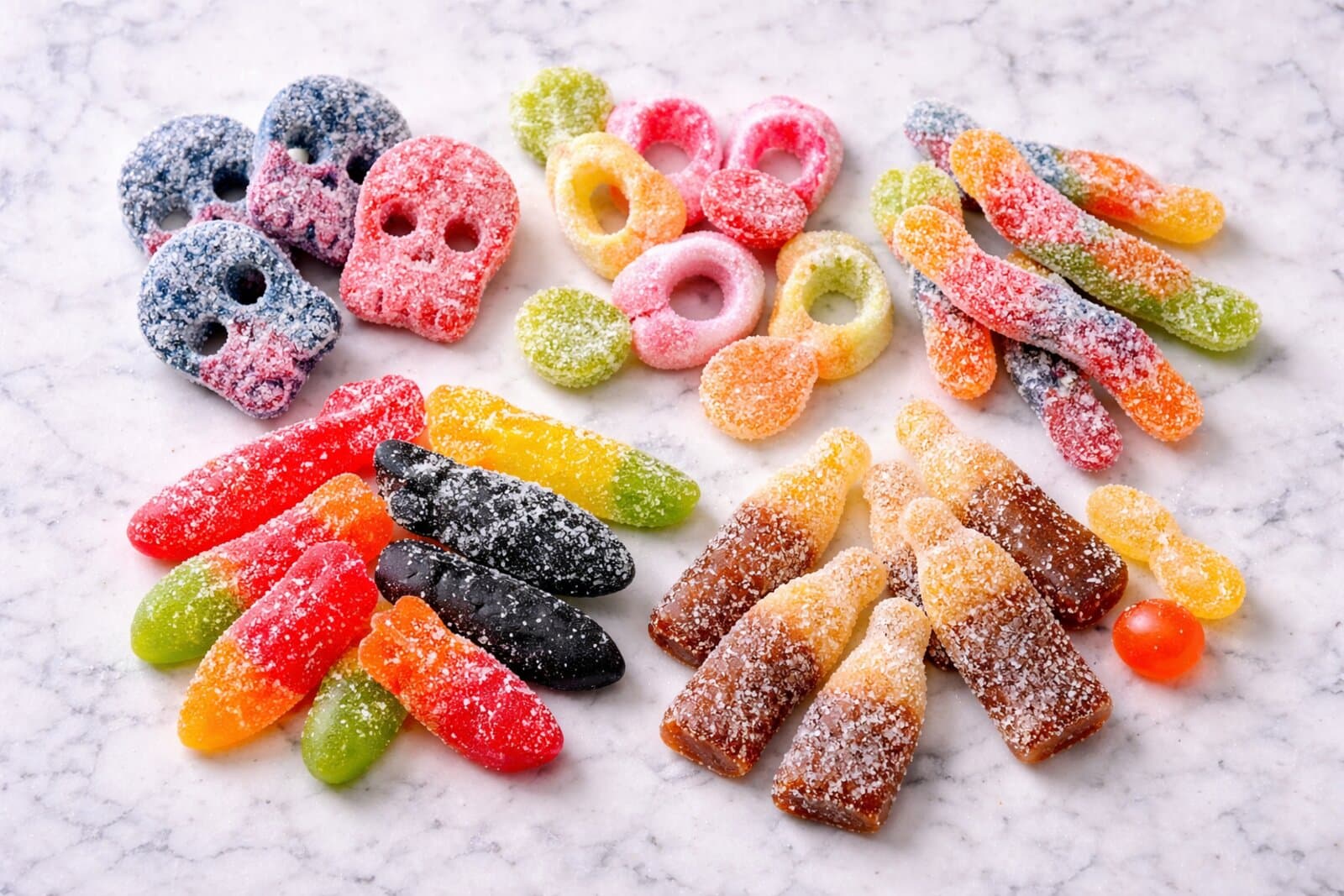
It's the question everyone asks after learning about Swedish candy: is it actually healthier? The answer is more nuanced than TikTok makes it seem. Let's break down the ingredients, the sugar content, and the regulatory differences for a real answer.
The Honest Answer: Healthier BY COMPARISON, Not Actually Healthy
Let's start with the fundamental reality: Swedish candy is still candy. It's packed with sugar. It's designed to taste good, not to fuel your body. No amount of natural dyes or EU regulations changes the fact that you're eating something classified as candy.
But here's the nuance: Swedish candy is healthier than American candy. Not healthy—healthier. That's a meaningful distinction that's been lost in TikTok's binary "healthy" vs "unhealthy" framing.
Where Swedish Candy Wins
Artificial Dyes and Additives
American candy uses Red 40, Yellow 5, Yellow 6, and Blue 1—synthetic dyes that the EU labels with health warnings. Swedish candy manufacturers, unable to use these dyes commercially in Europe, switched to plant-derived colorings: beetroot juice, spirulina, and carrot concentrate.
Is this healthier? For the general population, probably not noticeably. For people with dye sensitivities (more common than most people realize), yes—it's substantially healthier. For parents trying to minimize artificial additives in their kids' diets, yes.
But the person without sensitivities eating Red 40 isn't poisoning themselves. It's approved by the FDA. It's just that the EU disagrees with the risk/benefit calculation.
No High Fructose Corn Syrup (HFCS)
This is where the real ingredient difference emerges. Most American candies use HFCS as their primary sweetener. Most Swedish candies use sugar.
Why this matters: HFCS is cheaper than sugar, which is why American manufacturers prefer it. Your body processes HFCS slightly differently than regular sugar—it hits your liver harder and may contribute more directly to fatty liver disease with heavy consumption.
The health difference isn't massive, but it's real. A gram of sugar and a gram of HFCS aren't nutritionally equivalent.
Fewer "Unpronounceable Chemicals"
Swedish candy ingredient lists are shorter. You see things like "fruit juice concentrate," "gelatin," "sugar," "gum arabic." American ingredient lists often include emulsifiers, stabilizers, and preservatives that Swedish candies don't need (either because EU regulations are stricter or because the distribution chain is shorter).
Are these mystery chemicals poison? No. Are they unnecessary for the actual product? Mostly yes. Fewer ingredients you can't pronounce is legitimately "cleaner," even if it's not directly healthier.
Where Sugar Content Tells the Real Story
Here's where things get uncomfortable for the "Swedish candy is healthy" narrative:
Swedish vs American Candy: Sugar Content Comparison (per 100g)
| Candy Type | Swedish Brand | Sugar/100g | American Equivalent | Sugar/100g | Difference |
|---|---|---|---|---|---|
| Sour Gummies | BUBS Sour Skulls | 72g | Sour Patch Kids | 74g | Swedish: -2g |
| Sour Gummies | Ahlgrens Bilar | 75g | Haribo Gummy Bears | 77g | Swedish: -2g |
| Soft Licorice | Malaco Super Sura | 68g | Twizzlers | 71g | Swedish: -3g |
| Hard Candy | Bilar Chocolate | 73g | Life Savers | 84g | Swedish: -11g |
| Chocolate-Covered | Marabou Bilar | 62g | Reese's Peanut Butter Cup | 51g | Swedish: +11g |
What this actually shows: Sometimes Swedish candy has slightly less sugar. Sometimes it has more. The difference is marginal (1-3%) most of the time. A BUBS Sour Skull and a Sour Patch Kid have virtually identical sugar content.
This is the part that kills the "Swedish candy is healthier" argument: the sugar is the same. Your teeth will decay the same. Your blood sugar will spike the same. Your daily calorie intake increases the same.
The EU Regulations Advantage (But It's Smaller Than You Think)
The EU regulates food more strictly than the US. This is actually true. But here's what it means in practical terms:
- No artificial dyes (replaced with natural ones that often taste and look slightly different)
- No HFCS (replaced with regular sugar, which is still sugar)
- No certain preservatives (but most modern Swedish candy doesn't need them due to packaging and distribution)
- Stricter on GMO ingredients (though most American candy isn't GMO in the first place)
What EU regulations DON'T do: lower sugar content, reduce calories, make candy nutritious, or change the fundamental fact that candy is candy.
Common Swedish vs American Candies: Real Comparison
BUBS Sour Skulls (Sweden) vs Sour Patch Kids (USA)
Sugar content: 72g vs 74g per 100g (negligible difference)
Main ingredient: Sugar vs Corn Syrup/Sugar blend
Artificial dyes: None (spirulina, beetroot, carrot) vs Red 40, Yellow 5, Yellow 6, Blue 1
Healthiness verdict: Slightly better for people avoiding artificial dyes. Otherwise equivalent from a nutritional standpoint. Both are ~70 calories per serving.
Ahlgrens Bilar (Sweden) vs Haribo Gold-Bears (USA)
Sugar content: 75g vs 77g per 100g (negligible difference)
Main differences: Swedish version uses fruit juice concentrate for flavor; American version uses corn syrup and artificial flavors. Swedish uses natural dyes; American uses synthetic.
Healthiness verdict: Marginally better ingredients in Swedish version. Same sugar, same calories, same cavities.
Swedish Licorice vs American Licorice (Twizzlers)
Sugar content: 68g (Swedish) vs 71g (American) per 100g
Real difference: Swedish licorice often uses real licorice extract and gum arabic. American licorice is mostly sugar and corn syrup with licorice flavoring added.
Healthiness verdict: Swedish wins here because you're actually getting licorice compounds. But it's still candy with similar sugar content.
The TikTok Myth: "Swedish Candy Has No Sugar"
This is patently false. Swedish candy has the same amount of sugar as American candy. Sometimes slightly less, sometimes slightly more. The ingredient quality is better, but not the sugar content.
Videos showing people "shocked" at the sugar content of American candy as if Swedish candy is different are misleading. A 100g bag of Swedish gummies has roughly 72-75g of sugar. A 100g bag of American gummies has roughly 74-77g of sugar.
You can't "hack" your way to healthier candy by switching nationality. It's still candy.
When Swedish Candy IS Actually Better
If you have artificial dye sensitivities
For people who experience hyperactivity, headaches, or allergic reactions to Red 40 or Yellow 5, Swedish candy is materially better. This is a real health benefit—not a marketing claim.
If you're trying to minimize additives
Parents who want their kids to eat cleaner ingredient lists have a legitimate reason to choose Swedish candy. Fewer artificial additives means fewer things that could potentially cause problems, even if the risk is small.
If you want to support different regulatory standards
If you believe the EU's precautionary approach to food safety is better than the FDA's risk-based approach, buying Swedish candy votes with your wallet. It's a philosophical position, not a health one.
The Real Reason Swedish Candy Went Viral
It wasn't because it's healthier. It was because TikTok creators found a gap in regulations and sensationalized it. "American candy has BANNED INGREDIENTS" gets views. "Swedish candy has slightly fewer artificial additives but the same sugar content" doesn't.
Swedish candy is genuinely different. Better ingredients in some cases, cleaner labels, no artificial dyes. But different doesn't mean healthier. It means different.
The Honest Health Recommendation
If you're trying to eat healthy: Don't rely on Swedish candy being better. All candy is candy. Moderate consumption matters more than national origin. A small handful of BUBS gummies is fine; a large bag of BUBS gummies daily is not "health food" just because it's Swedish. If you genuinely need the sugar gone, Sweden does have a dedicated low-sugar segment — see our honest guide to sugar free Swedish candy brands like Pändy and Tweek.
If you want to optimize candy choices: Swedish candy is legitimately better in ingredient quality and dye usage. But the health impact is marginal. Choose based on taste and dye sensitivities, not because you believe it's health food.
If you have dye sensitivities: Swedish candy is genuinely better for you. The artificial dyes in American candy might trigger symptoms; Swedish candy's plant-based colorings won't.
FAQ
Q: Does Swedish candy have less sugar than American candy?
A: No. Per 100g, they're nearly identical (typically within 1-3%). A BUBS Sour Skull (72g sugar/100g) is virtually the same as a Sour Patch Kid (74g sugar/100g). The major difference is the type of sweetener (regular sugar vs HFCS), not the amount. Both are primarily sugar.
Q: Is Swedish candy actually healthy?
A: No. It's healthier than American candy in specific ways (fewer artificial dyes, no HFCS), but it's still candy. The sugar content is the same. The calories are the same. Eating large quantities of Swedish candy daily is not health-conscious. It's moderately better quality candy, not health food.
Q: Why do people say American candy is banned in the EU?
A: Because some ingredients used in American candy (like Red 40 and Yellow 5) require warning labels in the EU, making them commercially impractical for European manufacturers. They're not technically banned—they require "May have an adverse effect on activity and attention in children" labels, which most companies avoid. The dyes are approved in the US with no warning required.
Q: Should I switch to Swedish candy?
A: If you have artificial dye sensitivities, yes. If you prefer cleaner ingredient lists, yes. If you think it's healthier because of sugar content, no—it has the same sugar. If you like the taste, absolutely. But don't expect it to be a health upgrade. It's a quality upgrade, not a health upgrade.

Founder & Editor
Former Swedish candy & FMCG professional turned US-based founder of SwedishCrave. Built the site to fill the gap he saw when he moved stateside.