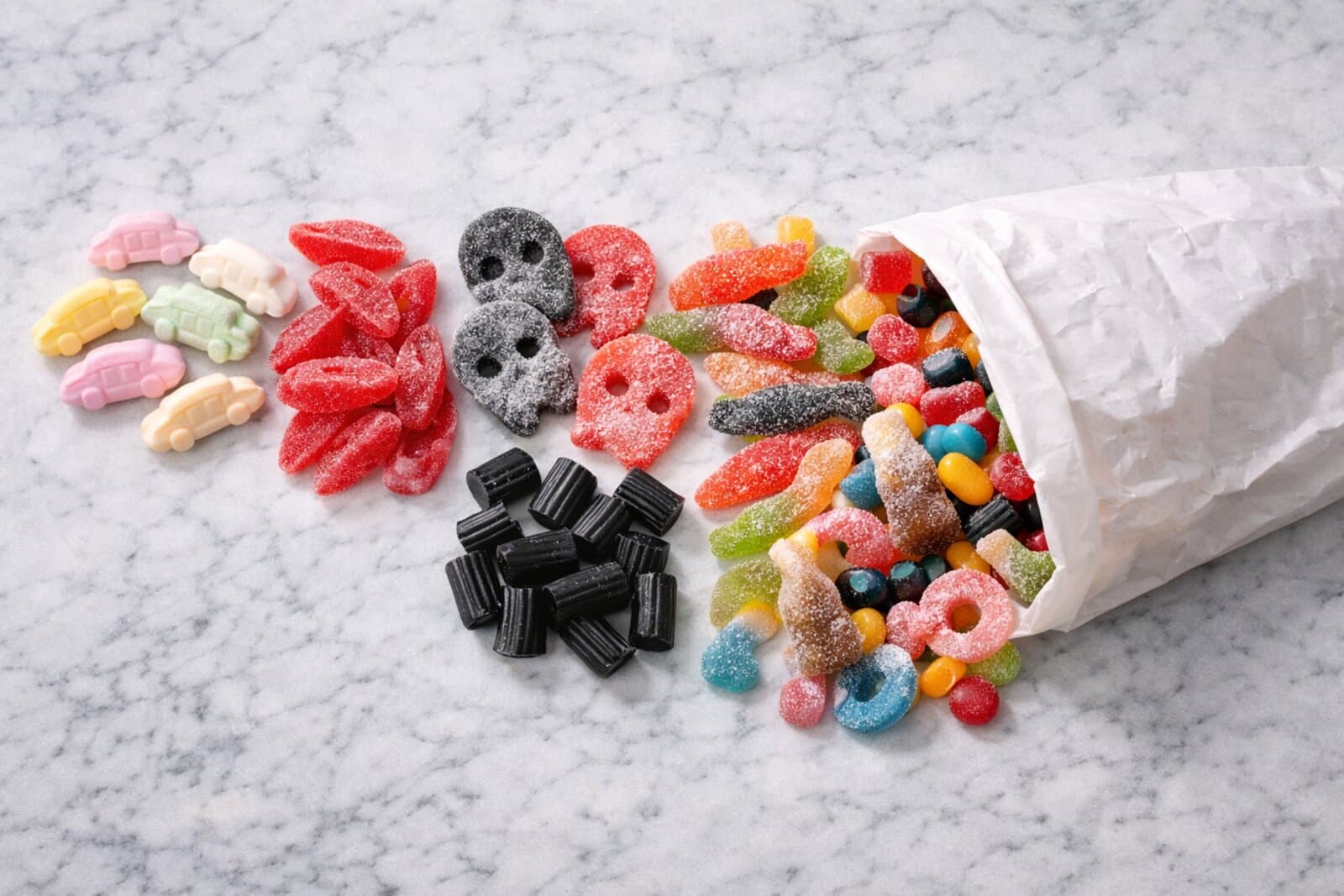
The reason Swedes only eat candy on Saturdays traces back to one of the most ethically controversial experiments in Scandinavian medical history. The Vipeholm experiments deliberately gave patients with intellectual disabilities excessive amounts of candy — and the results changed Swedish food culture forever.
What Were the Vipeholm Experiments?
Between 1945 and 1955, one of the most ethically troubling scientific studies ever conducted unfolded in the quiet Swedish city of Lund. At Vipeholm Hospital, researchers deliberately exposed intellectually disabled patients to controlled diets high in sugary foods to study the relationship between sugar consumption and dental decay. The experiments, funded by the Swedish Medical Research Council and the sugar industry, produced groundbreaking findings about cavity formation — but at a devastating human cost. What emerged from this dark chapter of medical history would ultimately shape how millions of people consume candy today, including the beloved Swedish tradition of lördagsgodis (Saturday candy).
The Vipeholm researchers didn't set out to create a beloved cultural tradition. They were driven by genuine scientific curiosity about the relationship between diet and dental health. Yet their methods were so morally bankrupt that their work became a cautionary tale in medical ethics. The participants — vulnerable individuals institutionalized at Vipeholm — had no meaningful ability to consent to the experiments. They couldn't refuse participation. They couldn't withdraw when the procedures caused them discomfort or harm. They were simply subjects in a grand scientific experiment, their teeth and their suffering the price of knowledge.
The Historical Context: Post-War Sweden's Dental Crisis
To understand why the Vipeholm Experiments happened at all, you need to understand Sweden in the immediate aftermath of World War II. While Sweden remained officially neutral throughout the war, the conflict's economic ripples reached Scandinavian shores. The post-war period brought prosperity, but it also brought new challenges that Swedish public health officials had to confront.
Chief among these challenges was a dental crisis of staggering proportions. By the mid-1940s, approximately 99% of Swedes had experienced dental cavities. As living standards improved and access to food increased, Swedes were eating more sugar than ever before. The country was modernizing rapidly, and with modernization came dramatically increased sugar consumption. Dentists and public health officials watched with alarm as cavity rates climbed, particularly among children.
The conventional wisdom of the time suggested that the total amount of sugar consumed was the primary factor in cavity formation. But Swedish researchers wondered if there was more to the story. Was it just about quantity? Did the timing of sugar consumption matter? What about the physical properties of the sugar — whether it was liquid, solid, or sticky? These questions haunted dental researchers across Europe. The answers, they believed, could help Sweden develop better public health strategies to combat the cavity epidemic.
This was the intellectual climate that made the Vipeholm Experiments possible. Researchers believed they were pursuing important science that could benefit public health. They had funding from prestigious institutions. They had institutional approval. What they lacked was any genuine ethical framework for protecting their human subjects.
How the Experiments Worked
The research team at Vipeholm Hospital, working under the direction of dental researchers, designed a meticulous multi-phase study using approximately 436 institutionalized patients as subjects. The experimental design divided participants into different groups, each exposed to different dietary regimens involving sugar in various forms, quantities, and timing.
The initial phase was relatively benign: researchers simply observed the dental health of patients on their existing hospital diets, establishing baseline cavity rates. This observational period was essential for the scientific design but also gave the research an air of medical legitimacy that obscured what was coming.
The second phase introduced controlled sugar supplements. Some groups received sugar in liquid form during meals. Others received sugar as solid candy. Still others got sticky confections like toffee and caramels. The timing varied too — some groups consumed their sugar exclusively during meals, while others received sugar between meals throughout the day. Researchers meticulously tracked every variable: what type of sugar, how much, when it was consumed, and how long it remained in contact with teeth.
Then came the phase that would make Vipeholm infamous: the toffee phase. Researchers gave patients extremely sticky toffee candy between meals, multiple times per day. The toffee was deliberately chosen for its adhesive properties — it clung to teeth, coating surfaces and filling crevices, creating an ideal environment for cavity-forming bacteria to feast. The researchers watched as cavities developed and multiplied at alarming rates. They documented the destruction with clinical precision: X-rays, photographs, dental measurements. All while the patients, unable to understand or consent to what was happening to them, continued to receive the candy that was destroying their teeth.
The toffee phase was not accidental cruelty. It was deliberate experimental design. The researchers needed to demonstrate that sticky sugar consumed between meals was uniquely destructive, and the only way to prove that — within their ethical blind spot — was to inflict the damage and measure it.
The Results That Changed Everything
When the Vipeholm findings were published in 1954, they represented a genuine paradigm shift in dental science. The data was unambiguous and the conclusions were revolutionary: the frequency and physical form of sugar consumption mattered far more than the total amount consumed.
Specifically, the experiments demonstrated several key findings. Patients who consumed sugar only during meals — even substantial amounts — developed cavities at rates only marginally higher than baseline. The mouth, it turned out, could handle concentrated sugar exposure during meals because saliva production increases during eating, naturally washing away sugar and neutralizing acids.
But patients who consumed sticky sugar between meals? Their cavity rates exploded. The toffee group showed the most dramatic increases — some participants developed dozens of new cavities during the study period. The sticky candy adhered to tooth surfaces for hours, providing a constant food source for acid-producing bacteria. Without the natural cleansing effect of meal-related saliva production, the teeth were under essentially continuous acid attack.
The implications were profound. It wasn't just about eating less sugar. It was about when and how you ate it. A person who consumed a large amount of candy in one sitting during a meal would likely suffer less dental damage than someone who nibbled on a small amount of sticky candy throughout the day. This insight completely reframed how public health officials thought about sugar and dental health.
For the sugar industry, which had partially funded the research, the findings were a mixed blessing. On one hand, the results didn't call for eliminating sugar entirely. On the other hand, they clearly demonstrated that certain consumption patterns — particularly the between-meals snacking that candy companies encouraged — were devastatingly harmful to dental health.
The Ethical Horror
The scientific value of the Vipeholm findings cannot justify the methods used to obtain them. By any modern ethical standard — and by many ethical standards that existed even in the 1940s — these experiments were profoundly wrong.
The participants were among the most vulnerable people in Swedish society. They were individuals with intellectual disabilities, institutionalized in an era when "care" for such individuals often meant warehousing them in large facilities with minimal individual attention. They had no advocates. They had no legal protections specific to research participation. They couldn't understand what was being done to them or why.
The researchers deliberately caused harm. This wasn't a study where harm was an unforeseen side effect — cavity formation was the explicitly desired outcome of the toffee phase. Researchers needed cavities to form so they could measure and document the process. Every cavity that appeared in a participant's mouth was evidence of the experiment working as designed. The suffering was the data.
Many participants suffered lasting dental damage. Cavities don't heal themselves. The teeth that were destroyed during the experiments remained damaged, affecting participants' ability to eat comfortably and their overall health for years afterward. Some accounts suggest that participants experienced significant pain during the experiments, pain that was noted clinically but not addressed with urgency because the experiment required ongoing sugar exposure.
The Vipeholm Experiments are often compared to other notorious mid-20th century research abuses: the Tuskegee syphilis study in the United States, various Nazi medical experiments, and other cases where vulnerable populations were exploited for scientific knowledge. While the scale and severity differ, the underlying ethical violation is the same: treating human beings as tools for scientific inquiry rather than as individuals deserving of dignity and protection.
Sweden has increasingly acknowledged the Vipeholm Experiments as a shameful chapter in its medical history. The experiments contributed to the development of stronger research ethics regulations, both in Sweden and internationally. But for the participants who suffered permanent dental damage, acknowledgment came too late and compensation never adequately materialized.
How Vipeholm Created Lördagsgodis
Here's where the story takes its most unexpected turn. The ethically indefensible Vipeholm Experiments produced scientific findings that Swedish public health officials translated into one of the most effective — and most charming — public health campaigns in modern history.
The logic was straightforward. The Vipeholm data showed that consuming candy between meals was the primary driver of cavities. Eliminating candy entirely was unrealistic in a society that loved its sweets. But what if candy consumption could be concentrated into a single, contained occasion each week?
Swedish public health authorities recommended exactly that: eat your candy once a week, all at once, preferably during or immediately after a meal. And the day they chose was Saturday. Lördagsgodis — Saturday candy — was born.
The recommendation resonated immediately with Swedish culture. Saturday was already a day of relaxation and family time. Adding a candy ritual to the weekend felt natural rather than restrictive. Children didn't experience lördagsgodis as deprivation — they experienced it as anticipation. All week long, they looked forward to Saturday, when they could visit the candy store and choose their weekly selection.
And it worked. Swedish cavity rates declined significantly in the decades following the introduction of lördagsgodis. Children who grew up with the Saturday candy tradition had measurably better dental health than previous generations. The concentrated once-a-week approach, exactly as the Vipeholm data predicted, proved far less destructive than daily candy nibbling.
The tradition also created the infrastructure that defines Swedish candy culture today. Pick-and-mix candy stores, where customers fill bags with individually selected pieces from dozens of varieties, evolved directly from the lördagsgodis tradition. When your candy consumption is concentrated into one weekly occasion, variety becomes essential — why eat the same thing every Saturday when you could mix and match from an enormous selection? This pick-and-mix culture led to the extraordinary diversity of Swedish candy that exists today.
🍬 Try Swedish Saturday Candy Yourself
Experience the candy tradition born from this history
Shop Swedish Candy at Mums →The Legacy Today
The Vipeholm Experiments remain a foundational case study in medical ethics education worldwide. They appear in textbooks and ethics courses as an example of research that crossed ethical lines so clearly that it became impossible to ignore. The experiments contributed to the development of stronger protections for human subjects in research, including the requirement for informed consent and institutional review of potentially harmful studies.
In Sweden, the legacy is more complicated. The nation takes justified pride in lördagsgodis as a cultural tradition that genuinely benefits public health. Yet this pride exists alongside growing acknowledgment of the ethical horrors that created it. Modern discussions of Swedish candy history increasingly emphasize both the scientific findings and the human cost of obtaining them.
The lördagsgodis tradition persists strongly today. Swedish children still anticipate Saturday candy. Families still make the weekly pilgrimage to the candy store. Pick-and-mix remains a cultural institution. The tradition is so deeply embedded that many Swedes who practice it have no idea about the Vipeholm Experiments that created it.
Perhaps the most important legacy of Vipeholm is the ethical lesson it teaches. Scientific knowledge, no matter how valuable, does not justify the exploitation of vulnerable people. The Vipeholm findings were genuinely important and have improved dental health for millions. But they were obtained through means that can never be repeated or excused. The challenge for Swedish culture — and for anyone who enjoys the candy traditions that Vipeholm spawned — is to honor both truths simultaneously: the tradition is wonderful, and its origins are terrible.
Frequently Asked Questions
When exactly did the Vipeholm Experiments take place?
The experiments ran from 1945 to 1955 at Vipeholm Hospital in Lund, Sweden. The most controversial phase — the toffee experiments — occurred during the later years of the study. The primary findings were published in 1954, and the experiments concluded the following year.
How many people were affected by the experiments?
Approximately 436 institutionalized patients with intellectual disabilities participated in the Vipeholm Experiments over the decade-long study. Not all participants were affected equally — those in the toffee phase suffered the most significant dental damage. Many experienced permanent harm that was never adequately addressed or compensated.
Is lördagsgodis still practiced in Sweden today?
Yes, lördagsgodis remains one of Sweden's most enduring cultural traditions. Most Swedish families still designate Saturday as candy day, and children grow up anticipating their weekly treat. The tradition has evolved — pick-and-mix candy stores have become elaborate retail experiences — but the core practice of concentrated weekly candy consumption persists across generations. You can explore where to buy Swedish candy to experience the tradition yourself.
Did the Vipeholm Experiments actually reduce cavities in Sweden?
The experiments themselves didn't reduce cavities — they caused them. But the findings from the experiments led to public health recommendations that dramatically improved dental health in Sweden. The lördagsgodis tradition, which emerged directly from Vipeholm's conclusions about sugar timing and frequency, contributed to significant declines in cavity rates among Swedish children in the decades that followed.
Are there similar experiments in other countries' histories?
Yes, the mid-20th century saw numerous ethically problematic medical experiments worldwide. The Tuskegee syphilis study in the United States (1932–1972), where Black men were deliberately left untreated for syphilis, is perhaps the most well-known parallel. These cases collectively drove the development of modern research ethics standards, including the Nuremberg Code and the Declaration of Helsinki, which now protect research participants from exploitation.

Founder & Editor
Former Swedish candy & FMCG professional turned US-based founder of SwedishCrave. Built the site to fill the gap he saw when he moved stateside.